There are no items in your cart
Add More
Add More
| Item Details | Price | ||
|---|---|---|---|

Five Systems Laws Every School Leader Must Understand
{{DATE}}
Most challenges in schools don’t appear overnight. Low engagement, teacher fatigue, inconsistent outcomes, initiative overload, these are rarely isolated problems. They are signals; Signals of deeper patterns quietly shaping daily life in our schools.
When we respond only to what’s visible, we stay busy but stuck. When we learn to see systems, we begin to lead with clarity.
Below are five essential systems laws, adapted specifically for schools, that help leaders move from firefighting to foresight while staying grounded in the philosophy of becoming 1% better every day.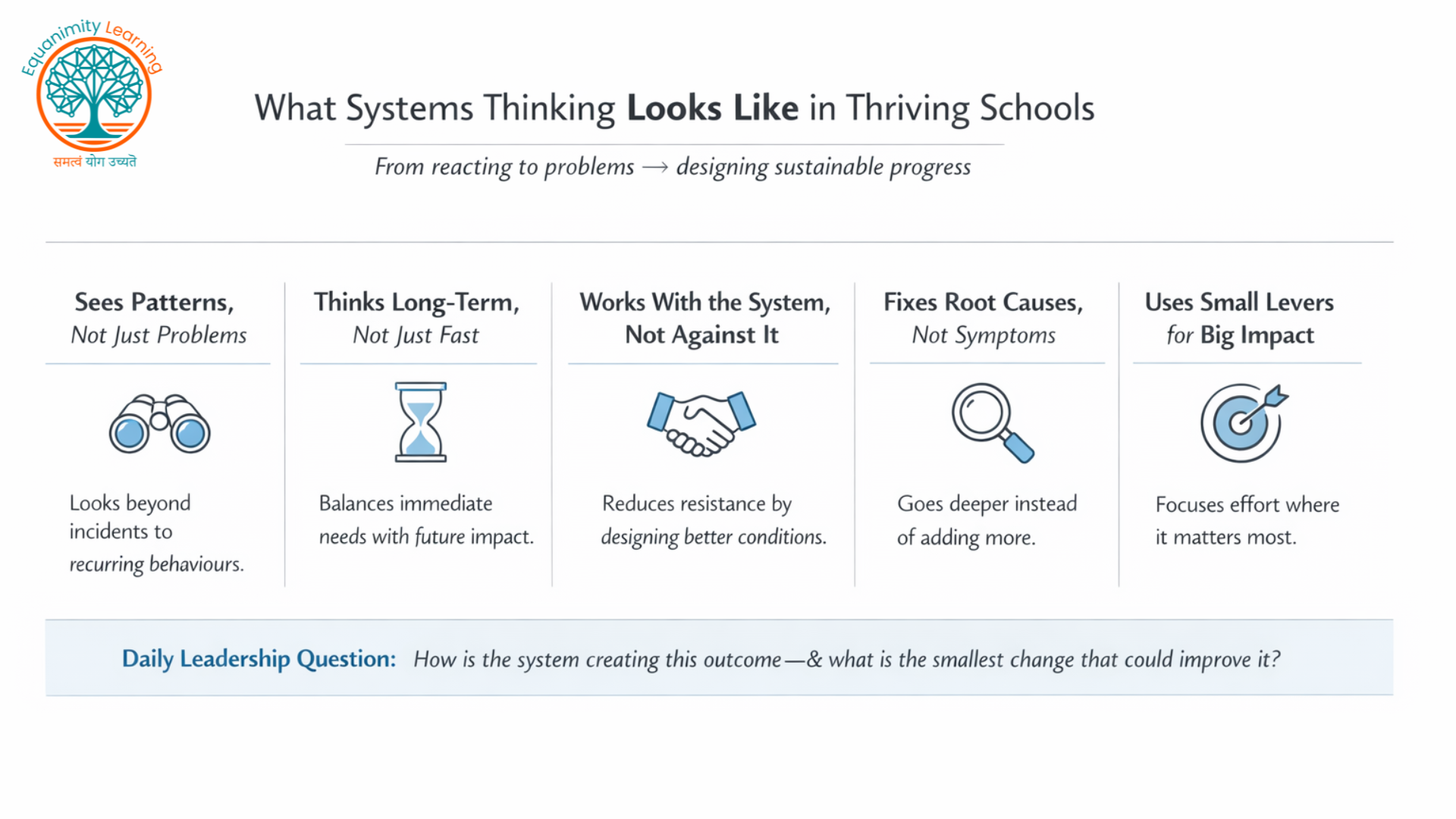
Many current school problems are the unintended results of past solutions that once worked.
In schools, this shows up as:
This law invites reflection, not regret. Systems are always teaching us.
Leadership move (1% better):
Before launching a new initiative, ask:
“What problem did we try to solve earlier and what pattern did it create?”
Learning begins when we examine our own history honestly.
Pressure may create compliance, but rarely commitment.
In schools, this looks like:
Human systems don’t respond well to force. They respond to meaning.
Leadership move (1% better):
Shift from driving change to designing conditions.
Involve teachers early. Listen longer than feels efficient.
Participation reduces resistance far more effectively than pressure.
Some strategies show immediate improvement but quietly weaken the system over time.
In schools, this appears as:
What improves quickly may decay slowly.
Leadership move (1% better):
Whenever something “works,” ask two questions:
Sustainable success requires patience and perspective.
Quick fixes keep schools busy but rarely better.
Common examples:
When root causes remain untouched, problems return often stronger.
Leadership move (1% better):
Slow down and go deeper.
Fix structures, not just symptoms.
Invest in habits, not just events.
Depth beats speed in real transformation.
The most powerful improvements often come from unexpected places.
In schools, leverage points might be:
Not all effort is equal. Some changes unlock energy across the system.
Leadership move (1% better):
Look for constraints, not complaints.
Ask: “Where is the system stuck and why?”
When the right lever is moved, progress accelerates naturally.
These laws invite a quiet but profound shift in leadership:
Great schools are not built on heroic effort alone.
They are built on thoughtful systems that help people do their best work, every day.
Sustainable improvement in schools is rarely dramatic.
When leaders respect how systems behave, change becomes calmer, clearer, and more human. That’s how schools grow not through constant pressure, but through consistent learning.
And that is what 1% better every day truly means.
This work is inspired by the systems thinking research of Peter Senge, and equally shaped by our ongoing research and hands-on experience across schools.
Through school audits, leadership work, and improvement cycles, we’ve seen these patterns play out repeatedly in real classrooms and staff rooms. This blend of theory and lived practice helps us co-create systems that work not in theory, but in schools.

{{AUTHOR}}
Transforming Education, One Step at a time.
 Launch your Graphy